

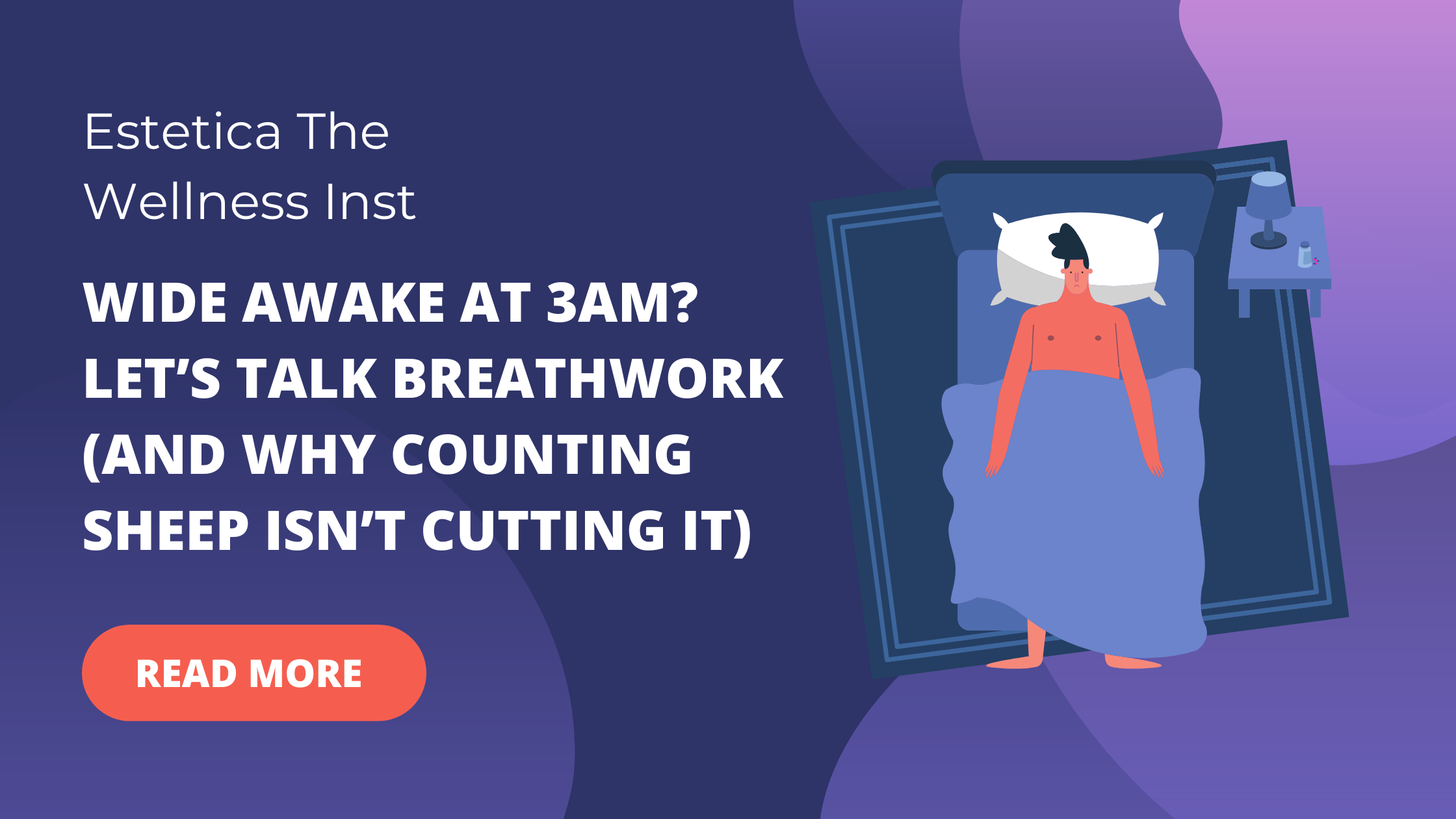
Wide Awake at 3am? Let’s Talk Breathwork (and Why Counting Sheep Isn’t Cutting It)
Wide Awake at 3am? Let’s Talk Breathwork (and Why Counting Sheep Isn’t Cutting It)
If you’ve ever:
Fallen asleep easily
Then woken at 2:47am staring at the ceiling
Replaying conversations from 2009
Welcome. You’re not broken. You’re wired.
Sleeplessness Isn’t a Sleep Problem
For many, sleeplessness is actually a nervous system issue.
Your body is tired.
Your brain is tired.
But your nervous system is still on high alert like it’s guarding the house.
This is where breathwork changes the conversation.
Why Breathwork Works (Without the Woo)
Your breath is the fastest way to communicate with your nervous system.
Slow, controlled breathing:
Activates the parasympathetic nervous system
Lowers cortisol
Increases vagal tone
Signals safety to the brain
In simple terms:
Your body finally gets the memo that it’s allowed to rest.
Why “Just Relax” Never Helps
You cannot think your way into sleep.
Trust me, many of us have tried.
Sleep happens when the body feels safe, not when the mind is convinced.
Breathwork works below conscious thought.
A Simple Night-Time Breath (Try This Tonight)
In bed, lights off:
• Inhale through the nose for 4
• Exhale slowly through the mouth for 6
• Pause gently for 2
Repeat for 3–5 minutes.
If your mind wanders — good. That means it’s loosening its grip. Having said that, imagine your thoughts on soft clouds passing by, then return to your breath. This way you have acknowledged that your thoughts are but you have control of them.
What Happens Over Time
Consistent breathwork:
✔ improves sleep quality
✔ reduces night waking
✔ supports hormonal balance
✔ calms anxiety at its root
And no — you don’t have to do it perfectly.
Your nervous system responds to consistency, not performance.
Final Thought
If you’re lying awake at night, your body isn’t failing you.
It’s asking for safety.
And sometimes, the most powerful thing you can do…
Is simply breathe.
If you’ve ever:
Fallen asleep easily
Then woken at 2:47am staring at the ceiling
Replaying conversations from 2009
Welcome. You’re not broken. You’re wired.
Sleeplessness Isn’t a Sleep Problem
For many women (especially in midlife), sleeplessness is actually a nervous system issue.
Your body is tired.
Your brain is tired.
But your nervous system is still on high alert like it’s guarding the house.
This is where breathwork changes the conversation.
Why Breathwork Works (Without the Woo)
Your breath is the fastest way to communicate with your nervous system.
Slow, controlled breathing:
Activates the parasympathetic nervous system
Lowers cortisol
Increases vagal tone
Signals safety to the brain
In simple terms:
Your body finally gets the memo that it’s allowed to rest.
Why “Just Relax” Never Helps
You cannot think your way into sleep.
Trust me — many of us have tried.
Sleep happens when the body feels safe, not when the mind is convinced.
Breathwork works below conscious thought.
A Simple Night-Time Breath (Try This Tonight)
In bed, lights off:
• Inhale through the nose for 4
• Exhale slowly through the mouth for 6
• Pause gently for 2
Repeat for 3–5 minutes.
If your mind wanders, good. That means it’s loosening its grip. This is the perfect time to imagine your thoughts passing by on the clouds.
What Happens Over Time
Consistent breathwork:
✔ improves sleep quality
✔ reduces night waking
✔ supports hormonal balance
✔ calms anxiety at its root
And no, you don’t have to do it perfectly.
Your nervous system responds to consistency, not performance.
Final Thought
If you’re lying awake at night, your body isn’t failing you.
It’s asking for safety.
And sometimes, the most powerful thing you can do…
Is simply breathe.
Progress Over Perfection: The Low-Tox Beauty Journey (No, You Don’t Have to Throw Everything Out)
The Perfection Trap
Many women start their low-tox journey with the best intentions:
“I’ll just swap a few things.”
Three Google searches later, they’re convinced:
Their lipstick is plotting against them
Their shampoo has a criminal record
And their favourite mascara is definitely toxic
Cue overwhelm. Cue paralysis. Cue… doing nothing.
And that’s where perfection becomes the enemy of progress.
Why Progress Wins Every Time
Your body is beautifully intelligent. It doesn’t need a perfect environment — it needs a reduced load.
Every product you swap:
✔ reduces cumulative exposure
✔ supports your skin barrier
✔ lightens the detox burden on liver and lymph
This is not an all-or-nothing game. It’s a long-term relationship with your body.
Start Where It Matters Most
If you’re wondering what to swap first, here’s a sensible (and sane) order:
Daily skincare (cleansers, moisturisers)
Foundation & lip products (they sit on the skin the longest)
Deodorant & body care
Hair products (especially scalp products)
You don’t need to give up performance or joy. Clean beauty has evolved — and so have we.
A Makeup Artist’s Confession
I’ve been in the beauty industry for over 20 years.
And yes — I still own products that wouldn’t make the “clean” cut.
No, the beauty police haven’t come for me.
What has happened is:
My skin is calmer
My hormones are happier
My clients with sensitive or mature skin see better results
That’s progress.
The Real Glow-Up
Low-tox beauty isn’t about fear.
It’s about informed choice.
And the most beautiful thing you can do?
Be kind to yourself while you learn.
Because confidence, calm, and self-trust…
Those are the most non-toxic things you’ll ever wear.
BLOG 2
Wide Awake at 3am? Let’s Talk Breathwork (and Why Counting Sheep Isn’t Cutting It)
If you’ve ever:
Fallen asleep easily
Then woken at 2:47am staring at the ceiling
Replaying conversations from 2009
Welcome. You’re not broken. You’re wired.
Sleeplessness Isn’t a Sleep Problem
For many women (especially in midlife), sleeplessness is actually a nervous system issue.
Your body is tired.
Your brain is tired.
But your nervous system is still on high alert like it’s guarding the house.
This is where breathwork changes the conversation.
Why Breathwork Works (Without the Woo)
Your breath is the fastest way to communicate with your nervous system.
Slow, controlled breathing:
Activates the parasympathetic nervous system
Lowers cortisol
Increases vagal tone
Signals safety to the brain
In simple terms:
Your body finally gets the memo that it’s allowed to rest.
Why “Just Relax” Never Helps
You cannot think your way into sleep.
Trust me — many of us have tried.
Sleep happens when the body feels safe, not when the mind is convinced.
Breathwork works below conscious thought.
A Simple Night-Time Breath (Try This Tonight)
In bed, lights off:
• Inhale through the nose for 4
• Exhale slowly through the mouth for 6
• Pause gently for 2
Repeat for 3–5 minutes.
If your mind wanders — good. That means it’s loosening its grip.
What Happens Over Time
Consistent breathwork:
✔ improves sleep quality
✔ reduces night waking
✔ supports hormonal balance
✔ calms anxiety at its root
And no — you don’t have to do it perfectly.
Your nervous system responds to consistency, not performance.
Final Thought
If you’re lying awake at night, your body isn’t failing you.
It’s asking for safety.
And sometimes, the most powerful thing you can do…
Is simply breathe.
If you’d like next:
SEO optimisation for these blogs
A gentler or cheekier tone
Short email versions
Insta carousel cut-downs
Or to brand these under Estetica Wellness Institute
Just say the word 🤍
Let’s get this out of the way first:
If anyone tells you that going low-tox means binning your entire makeup bag and starting again… kindly step away.
Because real life (and real skin) doesn’t work like that.
The Perfection Trap
Many women start their low-tox journey with the best intentions:
“I’ll just swap a few things.”
Three Google searches later, they’re convinced:
Their lipstick is plotting against them
Their shampoo has a criminal record
And their favourite mascara is definitely toxic
Cue overwhelm. Cue paralysis. Cue… doing nothing.
And that’s where perfection becomes the enemy of progress.
Why Progress Wins Every Time
Your body is beautifully intelligent. It doesn’t need a perfect environment, it needs a reduced load.
Every product you swap:
✔ reduces cumulative exposure
✔ supports your skin barrier
✔ lightens the detox burden on liver and lymph
This is not an all-or-nothing game. It’s a long-term relationship with your body.
Start Where It Matters Most
If you’re wondering what to swap first, here’s a sensible (and sane) order:
Daily skincare (cleansers, moisturisers)
Foundation & lip products (they sit on the skin the longest)
Deodorant & body care
Hair products (especially scalp products)
You don’t need to give up performance or joy. Clean beauty has evolved — and so have we.
A Makeup Artist’s Confession
I’ve been in the beauty industry for over 20 years.
And yes, I’m not perfect I wasn’t always a clean advocate, I have just let go of my last perfume bottle and I finally found a clean mascara, both wouldn’t make the “clean” cut.
No, the beauty police haven’t come for me.
What has happened is:
My skin is calmer
My hormones are happier
My clients with sensitive or mature skin see better results
That’s progress.
The Real Glow-Up
Low-tox beauty isn’t about fear.
It’s about informed choice.
And the most beautiful thing you can do?
Be kind to yourself while you learn.
Because confidence, calm, and self-trust…
Those are the most non-toxic things you’ll ever wear.